
Foundations
Foundations
UI/UX Design
UX Research
App Design
Visual Identity
Overview
Foundations is an app that blends neuroscience-backed insights with user research to help users create meaningful, lasting change.
This project was designed as a self-initiated case study during an interactive design course. Rooted in behavioural psychology and inspired by Atomic Habits by James Clear, this concept explores how intuitive, user-centered design can support sustainable habit change.

The Problem Space
Problem Statement
People often understand the value of healthier habits, yet struggle to maintain them consistently over time. General motivation alone is not enough to support long-term behaviour change.
Observation
Through behavioural research and observation, it became clear that habit failure is rarely caused by lack of motivation or knowledge. People often abandon habits due to overwhelm or lack of structure. Mornings and evenings - key transition points in the day - are especially critical in habit-forming.
Opportunity
There is an opportunity to support people with a calm, easy-to-use tool that helps them establish intentional morning and night routines. Creating a stable foundation for habits that shape daily life.
Understanding Competitors
Review existing apps focused on related themes to identify the strengths, gaps, and the unique selling points of this app.
Mindfulness Apps
(e.g., Headspace, Calm)

These apps focus on guided meditation, but they often lack interactive prompts, or a creative component, especially for outdoor engagement. My app stands out by combining mindfulness with physical activity and creativity.
Photography Challenge Apps (e.g., GuruShots)

Apps that encourage photo challenges tend to emphasize competition. My app instead focuses on personal exploration and mindfulness, which may appeal to users who aren’t interested in social competition.
Photography Apps
(e.g., Instagram, VSCO)

Does encourage photography but doesn’t include structured prompts or mindfulness elements. They could be used to encourage challenges and goals - but it is not a default feature and is more overwhelming of an app with too much distraction if the purpose is for mindfulness and being present.
Fitness Apps
(e.g., Strava, Nike Run)

These are usually step-focused, and emphasize physical activity but lack the creative and mindful approach. Some do have a feature for adding photos, but it is not a main feature of the app and more focus is put on metrics like distance and pace as goals.
Identified Differentiation
MuseWalk stands out by combining these three elements (physical/outdoor activity, mindfulness, and creativity) in an easy, straightforward way. It blends these into a single experience with daily prompts to encourage users to engage meaningfully with their environment, rather than focusing solely on metrics or being in their head.
MuseWalk emphasizes the value of experience over metrics, appealing to users who prioritize wellness and creativity over strict fitness or productivity goals.
The Approach
To design a habit-building experience grounded in behavioural science, I focused on understanding how people currently relate to habits: What motivates them, where they struggle, and why existing systems often fail.
Objective
Understand the motivations, challenges, and daily routines of individuals attempting to build better habits, with a focus on why habits break down over time.
Method
In-depth surveys with 10 participants exploring:
-
Existing habit-building attempts
-
Emotional and cognitive barriers for consistency
-
Motivations
Target Audience
Young adults aged 20-35 who are motivated to change but struggle with consistency and maintenence.
Conducting User Research
In-depth surveys were conducted with our target audience to get a more thorough understanding of their lived experiences.
Are there any habits you're actively trying to change? If so, what?
How do you usually attempt to build a new habit?
What is an example of a time you were trying to build a new habit but were unsuccessful?
What We Heard
Key themes emerged consistently across participants:
-
Individuals struggled with maintaining motivation beyond the initial excitement
-
Forgetfulness and lack of structure often caused habits to fade
-
Many participants shared a desire to wake up earlier and improve sleep routines
-
Individuals wanted guidance without feeling overwhelmed or pressured
"It's hard to get into a new routine and build it into my schedule - I find it easier to stop doing something than to start doing something new"
"Definitely coming up with reasons behind why the habits are a good idea would help me stick to them!"
"When trying to build new habits, I find it hard to have motivation to actually do them and remember them"
Creating Identities from Research: User Personas
A User Persona was crafted to reflect the target audience, based on research on user habits, needs, motivations, and competitors.

Understanding the User: Analyzing Findings
Goal: Translate behavioural insights into a focused, strategic app concept that supports sustainable habit change.
Parsing The Insights
User research revealed that habit-building is less about willpower and more about structure, consistency, and emotional safety. To move from research to product direction, I analyzed findings through the lens of behavioural psychology and neuroscience.
Actionable Insights
Taking insights from the research to shape the functionality and usability of the app.
Insight
Design Response
Motivation is unreliable without structure. New habits fade quickly when routines require too much effort or decision-making.
Create a system that reduces cognitive load by embedding habits into simple, repeatable routines, rather than relying on daily motivation.
People need guidance without pressure. Participants expressed a desire for support but felt overwhelmed by rigid systems and all-or-nothing tracking.
Design a calm, encouraging, non-punitive experience that focuses on progress over perfection.
Reflection strengthens habit formation.
Incorporate spaces where users are able to reflect on why this matters to them personally.
Morning and evening routines shape daily behaviour.
Frame the app around specific daily rituals (morning and evening) to help users start and end the day mindfully.
Small, consistent actions enable long-term change.
Support short-term, achievable actions that compound over time.
From Insights to Concept
These insights led to a key vision for the product. A habit-building app that motivates users gently but consistently - supporting both short-term actions and long-term transformation through structured and customizable morning and evening routines, rooted in intentionality and reflection.
Defined app features to support motivation, self-reflection, and habit reinforcement strategies in routines.
Framed the app around dual daily rituals (morning/evening) to help users stay grounded and aligned with focused, easily tracked goals.
Designing the Visual Identity & Interface Design
Goal: Design an interface that feels intuitive, motivating, and supportive, encouraging focus and consistency.
From Structure to Interface
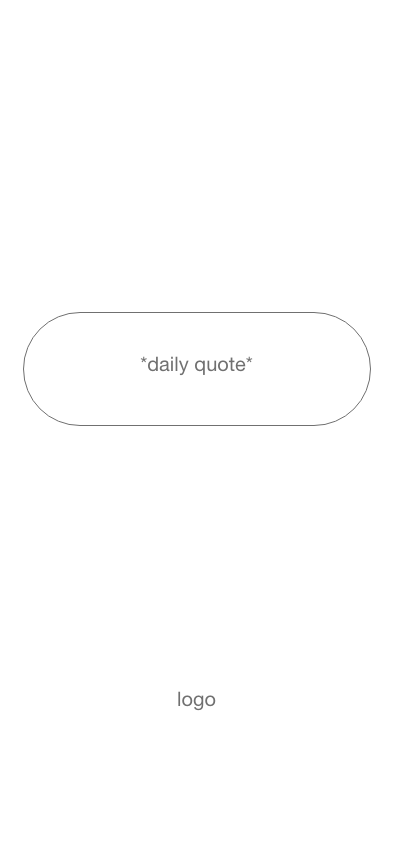
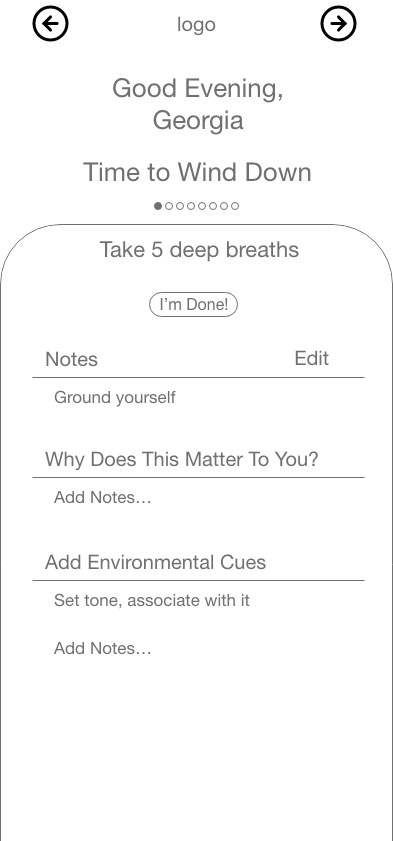
I began with low-fidelity sketches to explore layout ideas and user flows, then progressed to mid-fidelity wireframes to define:
-
Information hierarchy
-
Core navigation patterns
-
Key habit-building flows
Throughout this process, usability was prioritized by keeping tasks logically organized and navigation consistent and predictable, reducing cognitive effort for daily use.


Visual Language
The visual identity was designed to reinforce calm, balance, and growth - key emotional needs identified during research.
-
A harmonious colour palette of soothing blues and energizing greens supports clarity, focus, and renewal
-
Colour is used intentionally to guide attention without distraction
-
Visual contrast is kept soft to avoid creating pressure or urgency

App Icon
The app icon was designed to symbolize wholeness and duality, reflecting the balance between morning and evening routines. This visual metaphor reinforces the app’s core structure and philosophy of daily alignment through simple rituals.

Hi-Fi Design, Prototyping, and Usability Tests
With the visual identity established, I translated the wireframes into high-fidelity screens and built an interactive prototype. This allowed design decisions to be evaluated in context, rather than in isolation.
The prototype was used not only to visualize the experience, but to challenge early assumptions and identify friction points before further refinement.

User-Testing Script
To assess how intuitively users could move through the app, I conducted moderated, in-person usability testing with three participants from the target audience.
Participants were guided through realistic, goal-based tasks that reflected common usage scenarios, such as setting up routines and navigating between morning and evening flows. They were encouraged to think aloud while interacting with the prototype, followed by open-ended questions to capture impressions, expectations, and points of confusion.
Some of the key tasks included:
Navigate to the morning routine
Edit an evening routine
Create a new activity for the morning routine
Key Observations & Takeaways
Usability testing revealed valuable patterns across participants:
-
Natural navigation paths and areas where users hesitated
-
Moments of uncertainty around interaction cues
-
Feedback on visual clarity, hierarchy, and flow between screens
-
User expectations around transitions and task completion
These observations informed refinements to layout, interaction feedback, and navigation clarity to better support seamless daily use.
Final Design
Based on user feedback, the prototype was refined to improve ease of use and navigation.
The final result is a high-fidelity, interactive prototype that demonstrates the complete Foundations app experience, from onboarding to daily morning and evening routines.
The design balances behavioural psychology principles with intuitive UX patterns and a calm, motivating visual language. Every interaction was designed to feel supportive, and encourage consistency without overwhelm.

